Peter Lang · New York · 2020

C. S. Lewis and the Craft of Communication

One of the twentieth century's most-read writers left behind powerful principles of how to be understood. This book recovers those principles from Lewis's own words — and shows you how to use them.

304 Pages Hardcover · Softcover · eBook ISBN 978-1-4331-7234-2
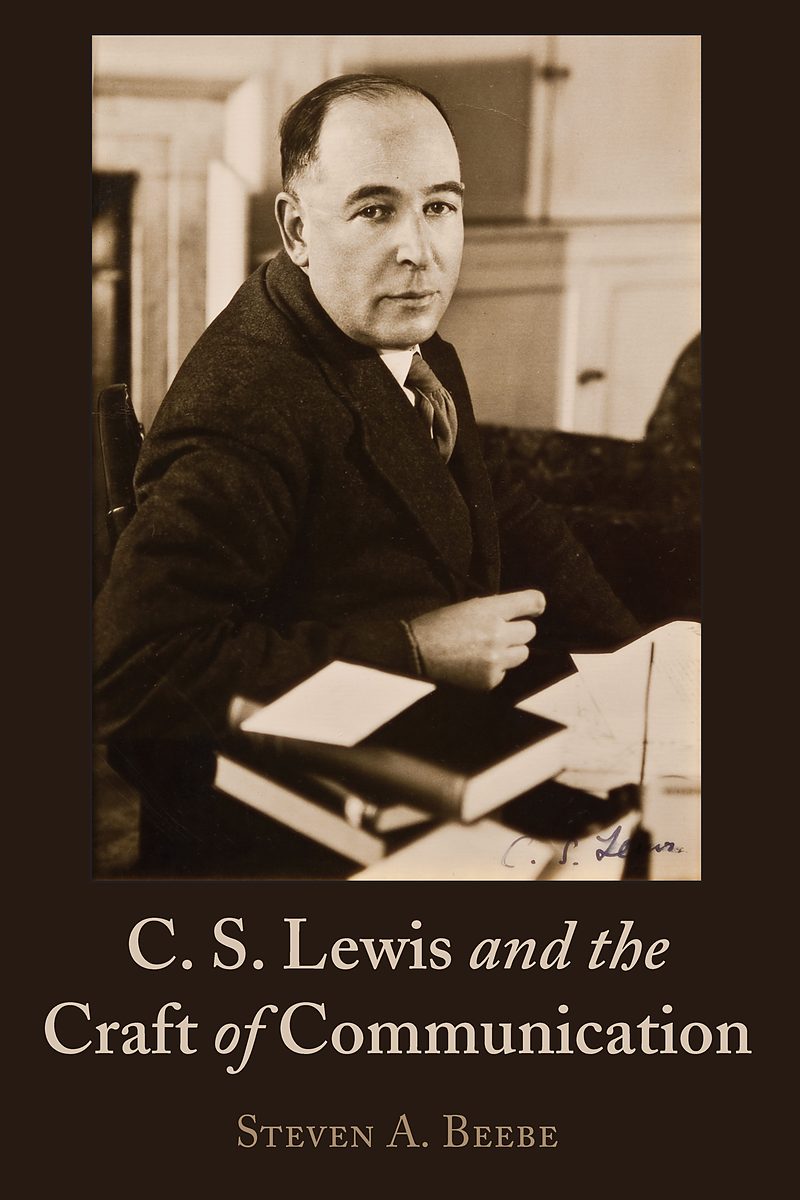
Cover of C. S. Lewis and the Craft of Communication by Steven A. Beebe
The Book

A Master
Communicator

Lewis, a communicator? If you think about it, of course.

Joel Heck · Concordia University Texas

C. S. Lewis is remembered as a novelist, a scholar, a Christian apologist, a broadcaster. He is rarely described as what he unmistakably was: one of the most effective communicators of the twentieth century — a man still read by millions more than half a century after his death.

C. S. Lewis and the Craft of Communication is the first book to focus on both C. S. Lewis coupled with the comprehensive skill of communication as its subject. Drawing on Lewis's books, essays, letters and lectures — and on decades of archival research at Oxford University — Steven A. Beebe identifies five principles that run beneath everything Lewis wrote and spoke, whether he was addressing a child, a philosopher, or a nation at war over the wireless.

The five are memorably summarized by an acronym Lewis himself would have appreciated: HI TEA. They are not a formula. They are a description of how a genuinely gifted communicator thinks — and they are learnable.

Written by a past president of the National Communication Association who has spent his career teaching people to speak and write more clearly, the book closes with a practical chapter: how to communicate like C. S. Lewis.

The Five Principles

HI TEA

A comprehensive review of Lewis's work reveals five communication principles that explain his success. Each one is drawn from Lewis's own advice — and from his practice.

H
Holistic

Communicate for both the eye and the ear. Use reason and imagination held together rather than traded off. Harness the power of rhetoric, dialectic and the poetic working as one instrument.

Chapter Four
I
Intentional

Have something to say, then say precisely that. Do the work of invention first — find what is actually there to be said before you look for a way to say it. Lewis was an enemy of the vague: for him, clarity was a moral matter as much as a stylistic one.

Chapter Five
T
Transpositional

Make the ineffable effable. Communicate from the richer to the poorer medium — by pouring a large idea into a smaller vessel without spilling it. The visual metaphor is the technique.

Chapter Six
E
Evocative

It's better to get a message out of someone than to put it in them. Place the reader in the middle of things. Tell stories. Use myth. Lewis wrote to make you feel the thing, not merely file it.

Chapter Seven
A
Audience-Centered

It always depends on the audience. The other person is the point. Lewis edited for his audience, related to it, and — instructively — sometimes misjudged it. He also knew how to be a good audience himself.

Chapter Eight

Be holistic. Be intentional. Transpose. Evoke. Begin and end with your audience.

The Discovery

The Book Lewis
and Tolkien
Never Wrote

In the 1940s, C. S. Lewis and J. R. R. Tolkien agreed to write a book together about language. Their publisher announced it for 1950. It never appeared, and for sixty years scholars assumed not a word of it had ever been set down.

In 2002, while researching at the Bodleian Library in Oxford, Steven Beebe was handed a small, battered, orange notebook on which Lewis had written a single word: Scraps. Inside were early fragments of the Narnia stories and loose ideas on a dozen subjects. Turning the notebook upside down and reading from the back forward, he found pages on language and meaning that he could not place.

Seven years later, the pieces fit. What he had been reading was the opening chapter of Language and Human Nature — the lost Lewis–Tolkien collaboration. The identification made international headlines and was published, with Beebe's commentary, in SEVEN: An Anglo-American Literary Review.

He went back. In 2016 and again in 2019 he found unknown, unpublished poems by Lewis in the same library — one of them a fourteen-line sonnet drafted in two separate corners of a working notebook. One of those poems appears in this book.

On the notebook marked "Scraps"

The manuscript had been catalogued, shelved and read for decades. It had simply never been recognized.

  • 2002

    The Bodleian

    A first encounter with the notebook — pages on language that fit nothing then known.

  • 2009

    Identified

    Beebe recognizes the fragment as the opening of Language and Human Nature. The story is carried worldwide.

  • 2011

    Published in SEVEN

    The transcribed manuscript and Beebe's analysis appear in volume 27 of the Anglo-American literary review.

  • 2016 · 2019

    Two Lost Poems

    Two previously unknown Lewis poems surface in the Bodleian. One is reproduced in this book.

  • 2020

    The Craft of Communication

    Peter Lang publishes the culmination of nearly two decades of Lewis research.

  • 2022

    Scholar of the Year

    Recognized for his pioneering research about C. S. Lewis by the Religious Communication Association.

Inside the Book

Nine Chapters

Three chapters establish the case and the man. Five unpack the principles. The last one puts them in your hands.

1

The Case for C. S. Lewis as Master Communicator

Popular communicator, professional communicator, professor of communication — and a first look at HI TEA.

2

The Making of a Master Communicator

Flora, Albert and Warnie. The Great Knock. Oxford. The war. Arthur Greeves. Tolkien. Joy.

3

C. S. Lewis's Big Ideas

Longing, the Tao, Christianity, and language as the metaphorical shaper of thought.

4

Holistic

One style, two Lewises, three methods — rhetoric, dialectic and the poetic.

5

Intentional

The meaning of meaning; Lewis as a master of invention; clarity and style.

6

Transpositional

Translation as prelude; transposition from richer to poorer; the visual metaphor.

7

Evocative

The right word, comparison, in medias res, story, and myth.

8

Audience-Centered

Learning from Lewis's failures as well as his triumphs — editing, relating, speaking, listening.

9

How to Communicate Like C. S. Lewis

The practical chapter: concrete habits for each of the five principles, from supporting material to eye contact.

With a Foreword by Jerry Root, Preface, Acknowledgements and Index. 304 pages.

What Others Are Saying

Praise

“I envy Dr. Beebe because he has learned from C. S. Lewis what it is like to be able to say exactly what he means.”
Walter HooperFormer secretary to C. S. Lewis · Literary Advisor to the C. S. Lewis Estate · author of C. S. Lewis: A Companion and Guide
“When Beebe turns his attention to C. S. Lewis, the combination is unbeatable: Lewis the master communicator, and Beebe the master teacher.”
Jerry RootProfessor Emeritus, Wheaton College · co-author of The Quotable C. S. Lewis
“A thoughtful, insightful, delightful book that informs, instructs and illuminates.”
Michael WardSenior Research Fellow, Blackfriars Hall, University of Oxford · author of Planet Narnia
“This important book offers clear and surprisingly practical insight into a truly remarkable communicator… I look forward to reading it again and again.”
Diana Pavlac GlyerProfessor, The Honors College, Azusa Pacific University · author of Bandersnatch and The Company They Keep
“Beebe's decades of Lewis scholarship… has led to this singular contribution that expands our understanding of and appreciation for Lewis.”
Diana K. IvyProfessor of Communication Studies, Texas A&M University — Corpus Christi
“Here indeed we find a great treasure… Beebe has brilliantly answered a question readers have long felt but perhaps never formed: How did Lewis communicate so clearly?”
Andrew LazoCo-editor of Mere Christians: Inspiring Stories of Encounters with C. S. Lewis
“As with Lewis, Beebe's love of the gift of language that all humans share is the foundation for truly understanding the important craft of communication.”
Colin DuriezAuthor of C. S. Lewis: A Biography of Friendship
“Steven Beebe has fine-tuned the Lewis biography with a wealth of freshly discovered details on the man and his writings.”
Bruce R. JohnsonGeneral Editor, Sehnsucht: The C. S. Lewis Journal
“We read the fascinating story of Beebe discovering a lost manuscript… the manuscript on communication that Lewis and Tolkien talked about writing together.”
Joel HeckProfessor, Concordia University Texas · author of Irrigating Deserts: C. S. Lewis on Education
“This book is a must-read for all who study the craft of communication… brimming over with insightful analysis.”
Will VausAuthor of Mere Theology: A Guide to the Thought of C. S. Lewis
“When you write a book about how effective C. S. Lewis was at communicating, then your presentation better be interesting and engaging to the reader. Beebe definitely delivers.”
William O'FlahertyAuthor of The Misquotable C. S. Lewis · host of the All About Jack podcast
Portrait of Steven A. Beebe
Photo © Lancia E. Smith
The Author

Steven A. Beebe

Steven A. Beebe (Ph.D., University of Missouri–Columbia) is Regents' and University Distinguished Professor Emeritus of Communication Studies at Texas State University, where he chaired the Department of Communication Studies for twenty-eight years while serving concurrently as Associate Dean of the College of Fine Arts and Communication for twenty-five. He previously spent ten years on the communication faculty at the University of Miami.

He is the author or co-author of fifteen books — editions totaling more than eighty-five volumes, including Canadian, Russian and Chinese printings — used by millions of students at hundreds of universities worldwide, along with more than seventy-five articles and book chapters. He served as president of the National Communication Association in 2013 and received its Wallace A. Bacon Lifetime Teaching Excellence Award in 2024.

A Visiting Scholar at both Oxford University and Cambridge University and a permanent member of the Wolfson College Common Room at Oxford, he taught a summer course on Lewis at Oxford for years: C. S. Lewis: Chronicles of a Master Communicator.

15Books
85+Editions
75+Articles & Chapters
3Lewis Discoveries
Summary Biography and Works
Watch, Listen & Read

Talks & Coverage

C. S. Lewis and the Craft of Communication
Order

Get the Book

Published by Peter Lang, New York — 2020. XXXII + 304 pages, with foreword, bibliographical references and index. Available directly from the publisher in three formats, and from major booksellers.

Softcover978-1-4331-7234-2
Hardcover978-1-4331-7233-5
eBookPDF · ePUB · Kindle
Order from Peter Lang
Get in Touch

Speaking & Inquiries

Dr. Beebe speaks on C. S. Lewis and on a range of communication topics — including “A Leader's Skill in Listening,” “We've Got to Stop Meeting Like This!” and “Audience-Centered Presentations” — for conferences, universities, congregations and corporate training programs. Media and scholarly inquiries are welcome.